

What Is Nursing Ausbildung?
Nursing Ausbildung in Germany has become one of the most popular pathways for students seeking stable healthcare careers in Europe. Students can earn while they learn in this dual vocational program, which blends classroom instruction with paid hospital experience. Before applying, many candidates research nursing jobs in Germany, nursing Ausbildung salaries, and nursing education for international students. This program offers a realistic, cost-effective, and career-focused path with high employment demand and extended residency prospects if you’re wondering how to become a nurse in Germany. With an ageing population and a growing shortage of healthcare workers, trained nurses enjoy excellent employment prospects, competitive salaries after graduation, and clear career advancement opportunities across hospitals, older people care facilities, and specialized medical centers.
Ausbildung Overview
- Dual education system
- Ausbildung takes 3 to 5 years (Full-time: 3 years, Part-time: up to 5 years)
- 1-2 days in School & 3-4 days in training
- Ensures strong jobs after graduation
- Training allowance in 3 years: starting from 1416€ /month
- B1 German language requirement
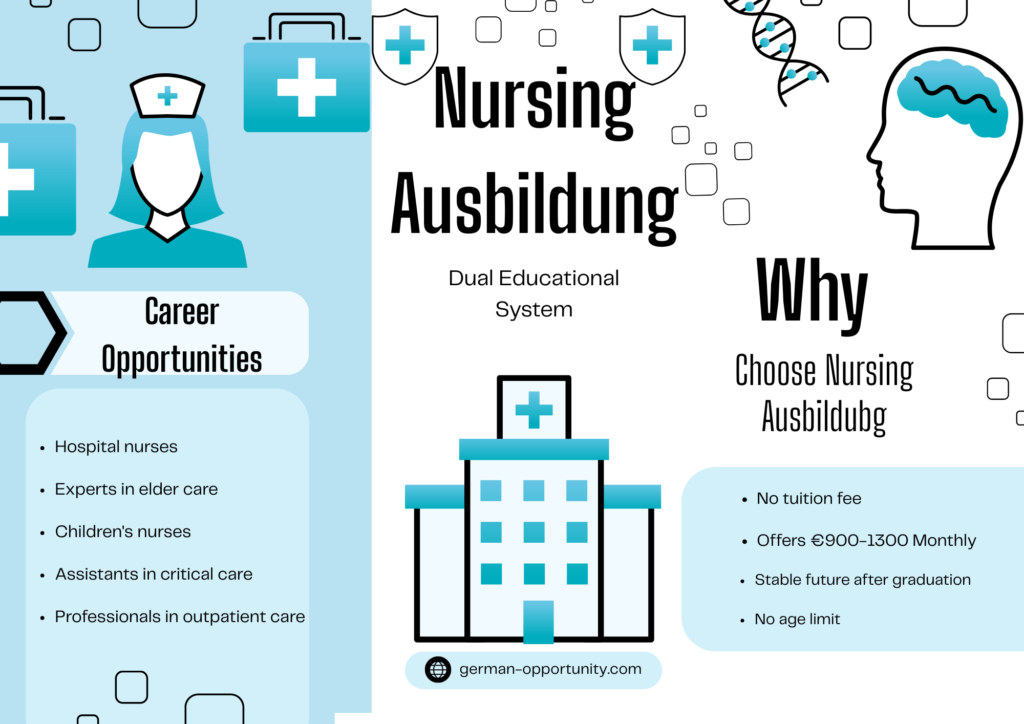
Nursing Ausbildung Duration and Weekly Structure in Germany
The program can be completed in two formats:
Full-Time Training: 3 Years
This is the standard model for most applicants. Training consists of:
- General nursing theory during the first two years
- A choice to specialize in the third year in General nursing, Pediatric nursing, Geriatric (older people) nursing. to become licensed nurses, trainees must pass a state exam at the end of the program.
Generalist Nursing Education Program
In 2020, a generalist nursing education program was introduced, including training to become a registered nurse. The initial training programs are combined and replaced by this one.
- Geriatric Nurse
- Registered Nurse
- Pediatric Nurse
Any aspect of nursing is included in the new generalist training program. However, obtaining specialist credentials as a pediatric or geriatric nurse will still be feasible until 2025.
Since the training to become a nursing professional is bundled, Nursing professionals may work in a variety of nursing roles, which is why their later activities can vary.
Part-Time Training: 5 Years
Several universities offer part-time options. These give students with personal or family obligations more flexibility.
Can I no longer become a geriatric nurse, registered nurse, or pediatric nurse?
Yes! These training programs are no longer available as stand-alone courses as of January 2020. Every student starts as a registered nurse. The registered nurse training program, however, still provides for distinct certifications as a pediatric nurse and a geriatric nurse. If you finish your apprenticeship in a suitable facility, you can really select between these two specializations during the last third of your training.
Nursing Ausbildung includes extensive hands-on practice in:
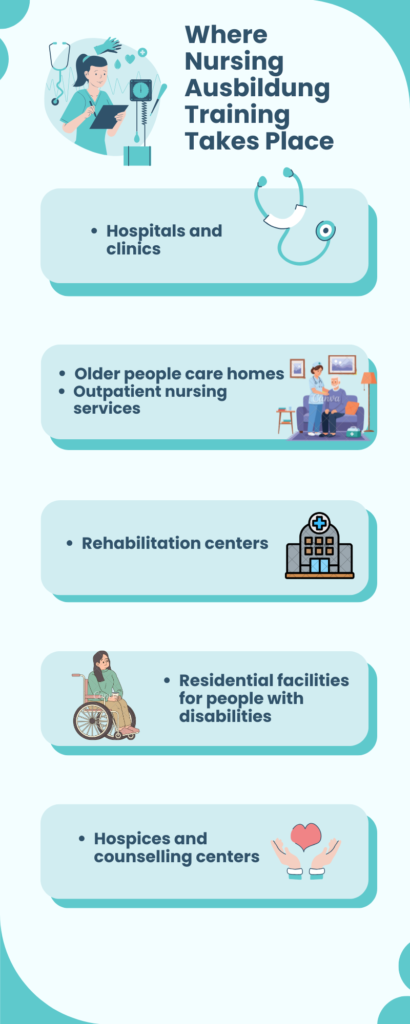
Moreover, students gain practical nursing skills. They also develop communication skills and teamwork through this real-world exposure.
What does a nurse do?
People’s health and well-being are the concern of nurses. They help with tasks such as medication administration, personal hygiene, and maintaining nursing reports.
Daily Tasks of Nursing Trainees
- Helping patients with everyday tasks like eating, taking a shower, and moving around
- Vital sign measurement and recording (blood pressure, temperature, pulse)
- Assisting physicians and senior nurses with procedures and treatments
- Medication administration under supervision
- Preparing patients for examinations and surgeries
- Keeping track of medical records and documents
- Maintaining standards for infection control and hygiene
- Providing patients and their families with emotional support and communication.
Salary During Nursing Ausbildung in Germany
Students make money while studying. This is a main benefit of the German vocational system.
Average gross salary of a Registered Nurse (During Ausbildung)
- 1 year: €1,380– €1,490
- 2nd year: €1,446– €1,552
- 3rd year: €1,553– €1,653
Entry Requirements for Nursing Ausbildung
The basic requirements to start Nursing Ausbildung in Germany typically include:
Education
- A secondary school certificate (equivalent to 10th–12th grade depending on the country).
- Some programs prefer science subjects, but it is not compulsory.
German Language Skills
- B1–B2 German level is required.
- B2 is preferred by many employers and educational institutions, particularly for patient communication.
Medical Fitness
- A certification attesting to your physical and mental fit for the nursing profession.
Clean Criminal Record
- A certificate of police clearance from your home country.
Age Range
- In Germany, there is no legal age restriction. Nonetheless, some private organizations or initiatives may favor candidates under 30.
Requirements for the Visa Application
Nursing Training Contract (Ausbildungsvertrag)
A signed training contract attesting to your enrollment in the Nursing Ausbildung program from a German nursing school or workplace is required.
German Language Proficiency
For nursing positions, a minimum of B1 German proficiency is required, with B2 highly recommended. Goethe-Institute, TELC, and ÖSD language certificates are accepted.
Educational Requirements
A valid 10th- or 12th-grade diploma (or its equivalent) is required. Every document needs to be validated and formally translated into German.
Financial Proof
As of 2026, you must have a minimum monthly net income of €959. A training wage is another piece of evidence if you intend to participate in a company-based vocational training program. Your livelihood is deemed secure if your training allowance is at least €1,048 gross or €822 net per month (as of 2026).
Passport
The duration of your expected stay in Germany must be at least 12 months longer than the validity of your passport.
Health Insurance
You must have valid German health insurance for the entire training period.
Visa Requirements for Non-EU Applicants
Before entering Germany for vocational training in Nursing, international students (from outside the EU/EEA) must apply for a residence permit. Typically, this procedure requires:
- An official training agreement.(Ausbildungsvertrag)
- Evidence of adequate proficiency in German.
- Financial evidence if your pay is less than the cutoff.
- A valid passport and supporting documents.
- Applying for a visa at the German Embassy.
Many applicants need 6–12 months for German learning and visa processing, depending on embassy workload.
Career Opportunities After Nursing Ausbildung in Germany
Graduates who complete the curriculum and pass the state exam can find employment as:
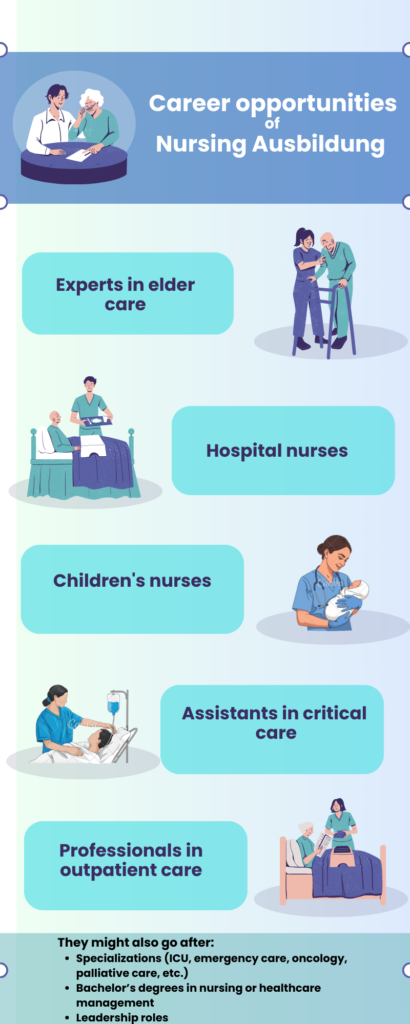
Estimated Annual Gross Salary For The Mentioned Careers (After Ausbildung)
| Nursing Role | Estimated Annual Salary |
|---|---|
| General Nurse (Registered Nurse) | €35,000 – €40,000 |
| ICU Nurse | €38,000 – €50,000 |
| Emergency Room (ER) Nurse | €38,000 – €48,000 |
| Pediatric Nurse (Children’s Nurse) | €35,000 – €40,000 |
| Geriatric Nurse (Older people care) | €32,000 – €42,000 |
Additionally, night shifts, weekend work, and public holidays may entitle students to extra compensation.
Salary After Nursing Ausbildung in Germany (Collective Agreements Comparison)
| Collective Agreement / Employer | Monthly Salary(€ Gross) | Salary with Allowances (€ Gross) | Estimated Annual Salary |
|---|---|---|---|
| Public Hospitals (TVöD Pflege) | €3,304 | €3,400–€3,700 (with shift & duty allowances) | €40,000–€44,000 |
| Caritas Deutschland (Western Region) | €3,304 | Around €3,550 including allowances | ~€42,600 |
Nursing apprenticeships in Germany
Thousands of vacancies available yearly on Ausbildung.de
Long-Term Residency in Germany after completing Nursing Training
- Skilled worker residence permit. PR eligibility depends on contributions, language, and employment stability
- German citizenship is based on the total number of years spent there.
You may learn more about the requirements for obtaining a settlement permission here.
Best Universities and Nursing Schools in Germany
With its top-notch education, state-of-the-art facilities, and internationally recognized degrees, Germany is one of the best places to study nursing and healthcare. Depending on their professional objectives, students can select from bachelor’s, master’s, and vocational nursing training (Ausbildung).
The top German universities and nursing schools are listed below, along with study choices and career prospects.
>
| University Name | Location | Program Name | Degree | Language of Instruction | Duration | Tuition Fee |
|---|---|---|---|---|---|---|
| Hof University of Applied Sciences | Hof | Cross-Cultural Nursing Practice | M.Sc. (Master of Science) | English | 4 Semesters | No Tuition Fee |
| Heidelberg University | Heidelberg | Interprofessional Healthcare | B.Sc. (Bachelor of Science) | English, German | 8 Semesters | Approx. €1,500 per semester |
| Private University of Witten/Herdecke | Witten | Nursing Science | M.Sc. (Master of Science) | English, German | 4 Semesters | Approx. €4,962 (total) |
Note: Tuition may apply for non-EU students depending on the federal state
Other Leading universities for Nursing Ausbildung
Other top universities offering health science and nursing programs at the university level include the following:
Charité – Universitätsmedizin Berlin
Charité is one of the top medical schools in Europe. It offers highly regarded nursing and health science programs with a strong clinical and research focus.
Munich’s Ludwig Maximilian University (LMU)
Unlike specialized vocational schools, Ludwig Maximilian University (LMU) Munich does not provide a direct Ausbildung (vocational training) curriculum. The university hospital, LMU Klinikum, serves as a practical training partner for nursing vocational schools in the Munich area.
University of Hamburg (UHH)
Vocational nursing training programs are not available at UHH. The Berufliche Hochschule Hamburg (BHH) offers a Bachelor of Science (B.Sc.) in Applied Nursing Science for students seeking an alternative to traditional schooling.
This program is ideal for those seeking a university-level nursing degree in Hamburg. It offers a monthly stipend and combines theoretical university study with practical training in healthcare institutions.
Technical University of Munich (TUM)
TUM combines healthcare innovation, research, and advanced nursing courses with vocational training to prepare students to become nursing specialists.
Study Nursing in Germany: Courses and Degrees
Germany places a strong emphasis on integrating hands-on practical training with academic learning as compared to other countries. This ensures graduates are well prepared for real-world healthcare settings from the start of their careers.
Dual Vocational Training (Ausbildung) in Nursing
Time frame: three years
Focus: Clinical processes, patient care, and practical nursing skills
Possibilities for Careers:
- A registered nurse
- Jobs in clinics and hospitals
- Care for the older people and outpatient services
Bachelor’s Degree in Nursing in Germany
Students who wish to have more employment alternatives and a stronger intellectual foundation can get a bachelor’s degree in nursing.
Time frame: three to four years
Areas of Focus:
- Science of Nursing
- Advanced medical care
- Management of healthcare
- Research techniques
Career Routes:
- Advanced nursing positions
- Administration of healthcare
Master’s Degree in Nursing in Germany
Graduates who wish to specialize or transition into leadership, teaching, or research roles should pursue a master’s degree in nursing.
Time frame: two years
Areas of Focus:
- Advanced medical practice
- Nursing leadership and management
- Education in nursing
- Research on healthcare
Career Routes:
- Roles of specialist nurses
- A nurse instructor
- Leadership and policy in healthcare
- research in academia and medicine
Nursing-Related Study Programs in Germany
Public Health
Population health, illness prevention, and health policy are the main topics of public health programs.
Areas of Focus:
Global health, health promotion, and epidemiology are the main areas of focus.
Careers:
consultant, epidemiologist, health educator, and public health nurse
Healthcare Management
Healthcare management programs train nurses for administrative and leadership positions.
Areas of Focus:
- Economics
- Quality control
- Health administration
Careers:
- Clinical director
- Healthcare manager
- Hospital administrator
Medical Informatics
Healthcare management programs train nurses for administrative and leadership positions.
Areas of Focus:
- Telemedicine
- Data management
- Health IT
Jobs:
- Clinical informatics
- Telehealth coordinator
- Health informatics specialist
How to Apply For Nursing Ausbildung (Step-by-Step)
- Learn German: Get a B1 or B2 level certificate in German from the Goethe-Institut, TELC, or ÖSD.
- Prepare documents: A motivation letter and a resume in German format (Lebenslauf).
- Translate Certificates: Obtain professional translators to translate and attest your school-leaving certificates (10th and 12th grade) into German.
- Search Vacancies: To locate nursing jobs, use German job boards such as Ausbildung.de or Bundesagentur für Arbeit (Pflegefachmann/frau).
- Apply Directly: Directly submit your application materials (resume, certifications, and proof of language) to nursing homes or hospitals.
- Interview: Get ready for online interviews, which are typically conducted using Zoom or Skype.
- Secure the Ausbildungsvertrag by signing the contract.
- Application for Visa: Present the contract to the German Embassy in your country of residence to apply for an Ausbildung visa.
Final Thoughts
If you are an international student looking for a stable and rewarding healthcare career, the Nursing Ausbildung in Germany is a great choice. It offers strong job prospects, financial support, and high-quality training, helping you build a secure future in Europe.