Germany Opportunity Card
The Germany Opportunity Card (Chancenkarte) is a new immigration program designed to attract skilled workers from non-EU countries. Germany has been opening its doors to non-EU skilled workers to address a shortage of qualified workers across various sectors.
Germany has introduced a new immigration tool, the Opportunity Card (“Chancenkarte”), which allows qualified and experienced individuals to enter Germany for one year to seek relevant jobs in the German labor market.
This card operates on a points-based system and evaluates applicants based on criteria such as education, work experience, language skills, and age.
This model is quite similar to the immigration model used by Canada and Australia, which selectively admits individuals who can fill skilled-worker shortages and benefit their economies.
Furthermore, if you have an academic degree or vocational qualification you obtained in Germany or are recognized in Germany, you don’t need to fulfill the minimum points requirement. You can directly apply for an opportunity card as a skilled worker. But you must meet the basic requirements in both cases.
Why the Opportunity Card is Important?
The opportunity card is important for several reasons, not only from Germany’s point of view but also for potential immigrants:
Addressing Labor Shortages:
Germany faces a workforce shortage due to low birth rates and an ageing population, particularly in sectors such as healthcare, engineering, IT, and manufacturing. German officials have predicted that by the end of 2060, there will be a shortage of 16 million workers due to the end of skilled immigration from abroad. This opportunity card is a strategic response to tackle this issue.
Enhancing Economic Competitiveness:
Germany is the fourth-largest economy in the world. Attracting skilled workers abroad boosts Germany’s productivity, innovation, and economic growth and helps Germany maintain or improve its financial position.
Streamlining Immigration Processes:
Traditionally, a visa is granted to skilled workers after they receive a job offer from a German company. However, the Opportunity Card allows potential skilled workers to enter Germany first and then find a job.
Supporting Germany’s Long-Term Demographic Goals:
The German population is getting older. There are fewer workers than retirees, which hinders economic growth and social welfare systems. By 2035, Germany is expected to have around 4 million people aged 67 or older. Bringing young talent into the country through opportunity cards will strengthen the workforce and support the country’s pension and healthcare systems in the future.
Benefits of Germany Opportunity Card (Chancenkarte)
The Germany Opportunity Card (Chancenkarte) offers several benefits. It offers non-EU workers a flexible approach to seeking work in one of Europe’s most robust economies.
1. Opportunity to Search for Jobs in Germany
The Opportunity Card’s ability to let qualified professionals enter Germany without a job offer is one of its main advantages. Candidates may remain in the nation for up to 1 year to seek appropriate employment.
2. Access to the German Job Market
In industries such as healthcare, IT, engineering, construction, and manufacturing, Germany is facing a skilled labor crisis. These job possibilities are readily accessible to qualified professionals through the Opportunity Card.
3. Part-Time Work Opportunities
While seeking full-time employment, Opportunity Card holders may work part-time. In addition to providing them with financial support, this gives them a head start in the German labor market.
4. Pathway to Long-Term Residence
You can convert your Opportunity Card into a work residence permit if you’ve found suitable employment in Germany. Permanent residency in Germany may result from this.
5. Points-Based Immigration System
The Chancenkarte uses a transparent points-based system, making it easier for skilled workers with qualifications, work experience, and language skills to qualify for the program.
Eligibility Criteria for Opportunity Card
Basic Requirements:
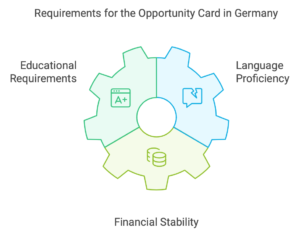
Educational Qualifications:
The minimum educational requirement to apply for the Opportunity Card as a skilled worker is a university degree or two years of vocational training obtained or recognized in Germany.
The minimum education needed to qualify for the Opportunity Card on a point basis is an academic degree or vocational qualification recognized in your country of origin.
- Language Proficiency:
To apply on a point basis, you must have German proficiency level A1, or your English language skills must be at least level B2.
Proof of Financial Stability:
Whether you apply on a point basis or as a skilled worker, you must demonstrate that you have enough financial resources to support yourself during your stay in Germany. You need to open a blocked account or a declaration of commitment for this purpose. The monthly fee for a blocked account is currently 1027 euros.
Overview of the Points System for Germany’s Opportunity Card:
If your qualification from your home country is fully recognized in Germany, you are eligible to apply as a skilled worker. If this is not the case, e.g., your qualification is partially recognized, or you have not gained your qualification in Germany, then you need to get at least a score of six points to obtain your Opportunity Card. The criteria for the points are given below.
Education:
- You will get 4 points if your qualification is found to be partially equivalent to the result of the process of recognition or equivalence of qualification. Furthermore, this applies to regulated professions, even if you need to complete additional steps (such as training or exams) to obtain a license to practice.
Qualification in a field with a shortage of professionals:
- You will get 1 point if your qualification is in a shortage occupation. You can easily find out whether your occupational field is in shortage or not in the list of shortage occupations.
Professional experience:
- You will receive 2 points if it’s proven that you have gained at least 2 years of professional experience within the last 5 years relevant to your qualifications. Moreover, 3 points will be awarded to you if you have 5 years of experience gained within the previous 7 years.
Language skills:
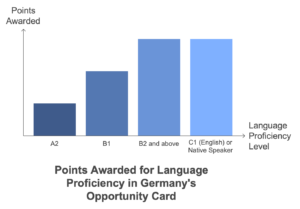
The more proficiency you have in German, the more points you will get. You will get 1 point if your German proficiency level is at A2, 2 points at the B1 level, and 3 points for the B2 level or above.
Furthermore, you will also be awarded points if your English language proficiency is at the C1 level or if you are a native English speaker.
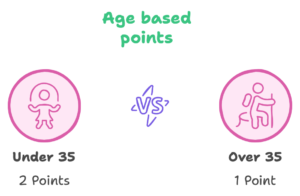
Age:
- 2 points will be awarded to you if you are under 35 years old. If you are 35 or older, you will receive 1 point.
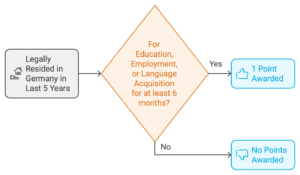
Prior Experience and Connections with Germany:
Have you legally resided in Germany for at least 6 months in the last 5 years for education, employment, or language acquisition?
If yes, then 1 point will be awarded to you. No points will be given if you have visited Germany solely for tourism, e.g., to spend holidays or visit family.
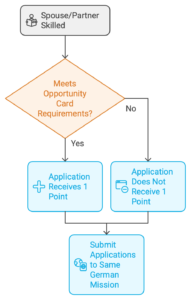
Submitting a Joint Application with a Partner
If your spouse/registered partner is also skilled and meets the requirements for the opportunity card, your application will receive 1 point. Both of you must submit your applications for the Opportunity Card to the same German mission.
How to Apply for the Germany Opportunity Card?
There are multiple steps involved in applying for the Germany Opportunity Card. Candidates must apply through the German embassy or consulate in their native country after determining their eligibility.
Step 1: Check Your Eligibility
Before applying, make sure you meet the basic requirements.
Step 2: Prepare the Required Documents
Obtain all required documentation, such as a passport, certificates of education and language proficiency, and evidence of financial means.
Step 3: Submit Your Application
Generally, you must apply for the Opportunity Card at the German embassy or consulate in your home country.
Step 4: Attend the Visa Appointment
You might have to attend a visa interview and provide biometric information.
Step 5: Wait for Approval
Once approved, you will receive your Opportunity Card visa.
Germany Opportunity Card vs Job Seeker Visa
International professionals can enter Germany to look for work using both the Germany Job Seeker Visa and the Germany Opportunity Card (Chancenkarte). However, these two immigration routes differ in several significant respects.
| Features | Opportunity Card (Chancenkarte) | Job seeker visa |
|---|---|---|
| System | Points-based immigration system | Qualification-based |
| Job Offer Required | Not Required | Not Required |
| Work While Job Searching | Part-time work allowed | Usually not allowed |
| Eligibility | Points based on age, education, language, and experience | Requires recognized university degree |
| Duration | Up to 1 year | Up to 6 months |
Conclusion
The Germany Opportunity Card, also known as the Chancenkarte, is an important step in Germany’s efforts to address its rising labor crisis and attract qualified experts from non-EU countries. The program enables eligible persons to visit Germany and seek work without a prior job offer, thanks to its clear points-based system.
The Germany Opportunity Card offers foreign professionals a great chance to investigate employment opportunities in one of the most robust economies in the world. Chancenkarte helps competent workers build a prosperous future in Germany.
If you meet the requirements for the Germany Opportunity Card, this program can be an excellent pathway to begin your professional journey in Germany and take advantage of the country’s diverse employment opportunities.